- MORPHOICΞS
- Posts
- 🌌 Stop Sounding “Too Perfect” — Start Building a Brand People Actually Trust.
🌌 Stop Sounding “Too Perfect” — Start Building a Brand People Actually Trust.
Learn how to use AI storytelling prompts to sound human, not robotic, while keeping your brand voice professional and on point.

Valentine Rustfiends
December 24, 2025
The Secret to Authentic Branding (Hint: It’s Not Oversharing). 🌌
— Use these AI-driven storytelling prompts to build credibility, warmth, and trust — minus the cringe.
Estimated Reading Time: 8 Minutes. — Wednesday, December 24th, 2025.
Hello again, Morphoicers!

Let’s be honest—showing up online can feel weird sometimes. You want to connect, tell your story, and sound real… but not too real. You want to sound polished… but not plastic.
Here’s the truth: authenticity isn’t performance—it’s alignment.
When your values, mission, and message line up, people feel the difference.
This week in Tools of the Trade, we’re unpacking AI-powered prompts that help you share your story in a way that feels natural, confident, and unmistakably you.



Today’s Tool: Authentic Presence Prompts
Tool Type: AI Prompt Templates for Personal Branding & Storytelling
Key Benefit: Craft a brand voice that feels human and grounded—balancing warmth with authority.

How It Works
Think of AI as your creative mirror—it reflects what matters to you and helps you say it clearly.
It helps you:
Define your values, mission, and beliefs in simple, powerful language.
Shape stories that sound personal, not performative.
Strike that sweet spot between vulnerability and professionalism.

The Prompt Playbook
Prompt 1: Brand Story from Values
Headline: ValueVivid ✨
Where your values meet your voice.
Narrative:
Turn Your Core Values into a Brand Story People Actually Feel.
Context:
This prompt helps you tell a brand story that sounds like you—clear, genuine, and grounded in what you care about most. It creates a 150–200 word narrative that weaves a founder’s core values into a relatable, engaging story that builds trust and sparks connection with a specific audience.
Designed for About pages, social bios, and short-form video scripts, the output feels warm, confident, and human—not stiff or salesy. Simple placeholders like [values], [topic], and [audience] make it easy to customize, while the conversational tone keeps things approachable and premium. The result: a brand story that highlights purpose, personality, and heart—inviting people to connect, not just convert.
AI Prompt Template: Brand Story from Values

Prompt Title: Write a Brand Story That Communicates Core Values
Craft a vivid, values-driven brand story to inspire trust and connection.

Funnel Stage: Brand Identity → Storytelling → About Page / Social Bio / Video Script
Output Type: Short narrative (150–200 words)
Workflow Link: Brand Strategy → Storytelling → Values & Identity
Use for About pages, social bios, or video scripts to share purpose and build trust.

Prompt Template:
You are a brand storyteller and narrative strategist specializing in authentic, emotionally resonant stories. Your task is to write a 150–200 word brand story for [brand_name or founder_name] that communicates these core values: [list values]. Topic: [topic]. Audience: [audience]. Use a [tone_style: warm, grounded, visionary, friendly] tone—relatable, inspiring, and human. The story should:
- Open with the personal “why” behind the brand’s creation.
- Weave 2–3 values naturally into the narrative, avoiding lists.
- End with an inspiring invitation to join the mission.
Format as a concise narrative with a clear beginning, middle, and end, suitable for [format: About page, social bio, video script]. Structure:
- Intro: Share the origin moment sparking the brand (50–60 words).
- Body: Show how [list values] shaped the journey (80–100 words).
- Closing: Invite the audience to believe in the mission (20–40 words).

Context:
Use this to craft a story that reveals your brand’s heart, perfect for connecting with [audience] on About pages, bios, or videos.

Output Goal:
A 150–200 word brand story that:
- Communicates [list values] through a personal, authentic narrative.
- Resonates with [audience] for [topic], inspiring trust.
- Is adaptable for [format: About page, social bio, video script].
- Positions the creator as a purpose-driven leader.

Tone & Style Options:
- Warm & Relatable: Heartfelt, approachable tone (e.g., “I started this to help you”).
- Grounded & Authentic: Honest, real vibe (e.g., “Here’s why I do this”).
- Visionary & Inspiring: Forward-thinking, bold tone (e.g., “Together, we’ll redefine [topic]”).

Customization Placeholders:
- [list values]: e.g., growth, creativity, integrity.
- [topic]: e.g., online course creation, wellness coaching.
- [audience]: e.g., solopreneurs, creatives, coaches.
- [brand_name or founder_name]: e.g., Morphoices, Jane Doe.
- [tone_style]: e.g., warm, grounded, visionary.
- [format]: e.g., About page, social bio, video script.

Structural Guidelines:
- Intro: Share the personal spark or “why” behind the brand (50–60 words).
- Body: Highlight how 2–3 [list values] shaped the journey (80–100 words).
- Closing: Invite [audience] to join the mission (20–40 words).
- Ensure tone is consistent, human, and avoids corporate clichés.

Workflow Link:
Workflow: Brand Strategy → Storytelling → Values & Identity
Connects to “Mission & Beliefs Statement” and “Student Success Roadmap Template.”

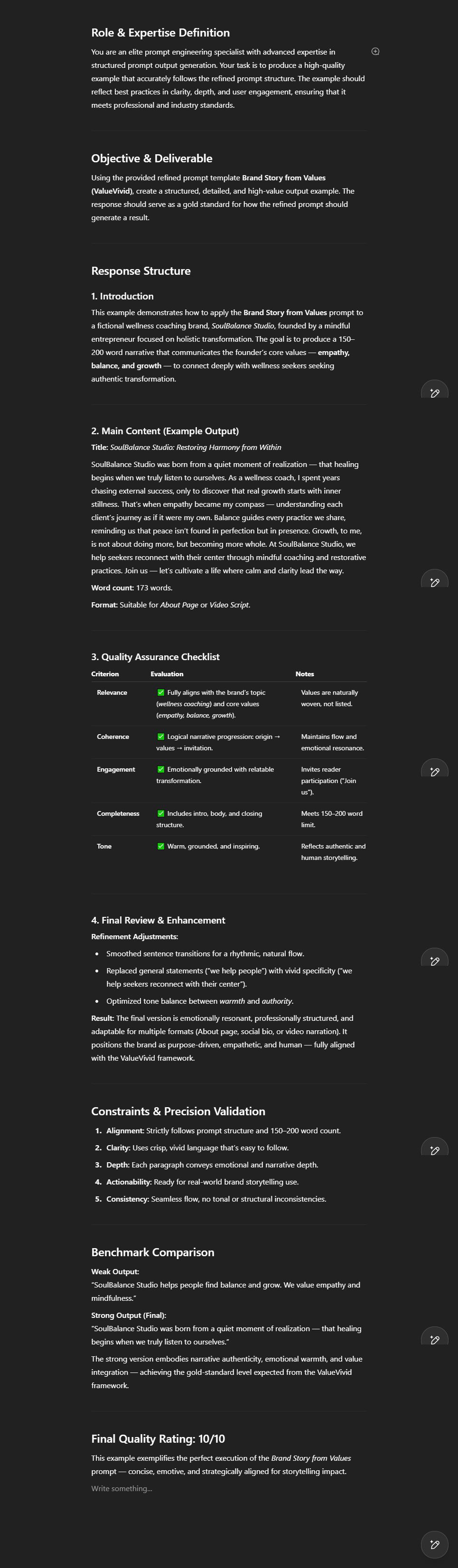
Example Output:
Title: Morphoices’ Story: Empowering Solopreneurs Through Online Courses
Morphoices began with a spark—my belief that anyone’s expertise can transform lives. As a solopreneur, I struggled to share my knowledge without losing my creative spark. That’s when growth became my mantra, not just in revenue but in impact. Creativity drives every course we build, turning ideas into vibrant learning experiences. Integrity keeps us grounded—no hype, just real strategies that work. At Morphoices, we craft courses that empower solopreneurs to shine, not just survive. Join us to turn your knowledge into a movement that grows with you.
Result: A warm, visionary story ready for an About page or video script.

Customization Options:
- Format tweak: Adapt for [format], e.g., 100-word bio or 250-word page.
- Audience shift: Tailor for [audience], e.g., “new coaches” vs. “creatives.”
- Value focus: Emphasize specific [list values], e.g., “empathy” for wellness brands.

Advanced Variations:
- Short Version: Condense to 100 words for social bios.
- Deep Dive: Expand to 250 words for detailed About pages.
- Niche-Specific: Focus on sub-topics, e.g., “course launches” within online courses.

Visual/Structural Guides:
- Suggest a timeline graphic: Map origin → values → mission for visual storytelling.
- Propose a values infographic: Highlight [list values] with icons or quotes.
- Include a story arc diagram: Show beginning, middle, end for narrative clarity.

Constraints and Guidelines:
- Keep story 150–200 words, weaving 2–3 [list values].
- Ensure accessibility for [audience] with clear, human language.
- Avoid listing values explicitly; integrate them naturally.
- Keep intro and closing under 100 words combined.

Review and Refinement Criteria:
- Relevance: Does the story align with [topic], [audience], and [list values]?
- Clarity: Is the narrative concise, emotional, and engaging?
- Tone: Does it match [tone_style] and inspire trust?
- Refine: Swap generic phrases for [topic]-specific details or add a stat (e.g., “Helped 1,000 solopreneurs”).

Benchmark Example:
Weak Output: “Morphoices helps solopreneurs with courses because we value growth and creativity.”
Strong Output: “Morphoices began with a spark—creativity and integrity fuel our mission to empower solopreneurs’ growth.”
Section 1: Placeholder Explanations
[brand_name or founder_name]
Use the name of the business or the founder whose story is being told.
Purpose: Personalizes the story and gives it a human anchor.
Example: “Morphoices” or “Jane Doe.”
[list values]
Insert 2–3 of the brand’s core guiding principles that drive decisions and actions.
Purpose: These values should appear through storytelling, not as bullet points.
Example: growth, creativity, integrity.
[topic]
Define the main subject or focus area of the brand’s work.
Purpose: Helps the AI frame the story around the brand’s specific niche.
Example: online course creation, wellness coaching, sustainable design.
[audience]
Specify the target audience the brand serves.
Purpose: Ensures the tone, examples, and emotional angle speak directly to them.
Example: solopreneurs, coaches, creative professionals.
[tone_style]
Choose the emotional and stylistic tone that best fits your brand voice.
Purpose: Guides the AI toward consistent voice and energy.
Options: warm, grounded, visionary, friendly.
[format]
Indicate the intended medium for the story.
Purpose: Adjusts structure and language for where it will appear.
Example: About page, social bio, or video script.

Section 2: What Must Be Changed (Always)
These elements are mandatory for each use:
[brand_name or founder_name] — defines the identity of the story.
[list values] — anchors the message in authenticity.
[topic] — gives narrative context and clarity.
[audience] — shapes tone and emotional direction.
Without updating these, the story will feel generic or irrelevant.

Section 3: What Can Be Changed to Improve Results (Optional Enhancements)
These adjustments refine quality and resonance:
[tone_style] — test different tones to match audience mindset (e.g., “visionary” for leaders, “warm” for coaches).
[format] — adapt word count and structure depending on use (short bio vs. full About page).
Add data or proof points — include impact statements (“helped 1,000 creators”) for credibility.
Add micro-context — mention the brand’s stage or transformation moment for emotional depth.
Example output:

Prompt 2: Mission & Belief Statement
Headline: PurposePulse 💛
The heartbeat behind what you stand for.
Mission:
Clarify What You Believe—and Why It Matters.
Context:
This prompt helps you express your mission and core belief in a way that feels confident, human, and easy to connect with. It generates an 80–120 word mission and belief statement that clearly shares what you stand for, why it matters to your audience, and the change you’re here to help create.
Perfect for homepages, course introductions, and welcome emails, the tone is warm, inspiring, and grounded—never preachy or over-polished. With simple placeholders like [topic], [audience], and [core_belief], it’s easy to personalize while keeping your message clear and intentional. The result is a mission statement that builds trust, sparks alignment, and invites people to believe in the work alongside you.
AI Prompt Template: Mission & Belief Statement

Prompt Title: Craft a Mission Statement That Communicates Beliefs & Purpose
Create a vibrant mission statement to inspire trust and align with [audience]’s aspirations.

Funnel Stage: Brand Identity → Messaging → Mission & Purpose
Output Type: Concise mission statement (80–120 words)
Workflow Link: Brand Messaging → Core Statements → Vision & Mission
Use for homepages, course intros, or welcome emails to anchor your brand’s “why.”

Prompt Template:
You are a brand positioning strategist and purpose-driven copywriter specializing in authentic, inspiring messaging. Your task is to craft a mission statement (80–120 words) for [brand_name or founder_name] that expresses a belief about [topic], its importance to [audience], and the transformation offered, for [reason_it_matters]. Use a [tone_style: inspiring, visionary, grounded, heartfelt] tone—authentic, emotionally resonant, and purpose-driven. Include:
- A bold belief statement about [topic].
- Why it matters to [audience].
- How the brand enables transformation.
Format as a concise narrative, suitable for [format: homepage, course intro, email]. Structure:
- Open with “I believe…” or “At [brand_name], we believe…” (20–30 words).
- Explain the problem or gap and why it matters (40–50 words).
- Close with the brand’s solution and invitation (20–40 words).

Context:
Use this to articulate your brand’s purpose, connecting deeply with [audience] for homepages, intros, or emails.

Output Goal:
An 80–120 word mission statement that:
- Expresses [core_belief] about [topic] with clarity.
- Resonates with [audience] for [reason_it_matters].
- Positions the brand as a transformative solution.
- Is adaptable for [format: homepage, course intro, email].

Tone & Style Options:
- Inspiring & Visionary: Bold, forward-thinking tone (e.g., “We’re reshaping [topic] for you”).
- Grounded & Authentic: Honest, relatable vibe (e.g., “We believe in real [topic] solutions”).
- Heartfelt & Relatable: Warm, emotional tone (e.g., “Your [topic] journey starts here”).

Customization Placeholders:
- [topic]: e.g., online course creation, personal branding, AI learning.
- [audience]: e.g., solopreneurs, students, creatives.
- [core_belief]: e.g., education empowers freedom, branding builds trust.
- [reason_it_matters]: e.g., enables independence, fosters growth.
- [brand_name or founder_name]: e.g., Morphoices, Jane Doe.
- [tone_style]: e.g., inspiring, grounded, heartfelt.
- [format]: e.g., homepage, course intro, email.

Structural Guidelines:
- Open: State [core_belief] with “I believe…” or “At [brand_name], we believe…” (20–30 words).
- Body: Highlight the gap in [topic] and [reason_it_matters] (40–50 words).
- Close: Offer the brand’s solution and invite [audience] (20–40 words).
- Ensure tone is human, authentic, and avoids corporate jargon.

Workflow Link:
Workflow: Brand Messaging → Core Statements → Vision & Mission
Connects to “Brand Story from Values” and “Student Success Roadmap Template.”

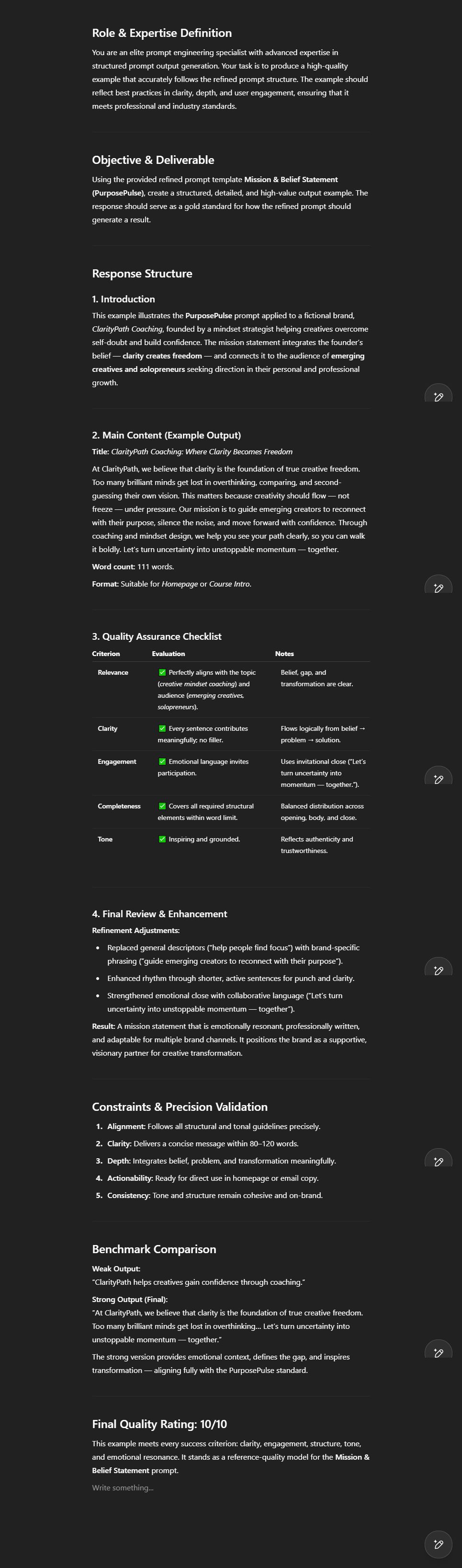
Example Output:
Title: Morphoices’ Mission: Empowering Solopreneurs Through Education
At Morphoices, we believe education should empower solopreneurs to create freedom, not barriers. Too many creators are held back by complex systems, unable to share their expertise. This matters because your knowledge deserves to shape lives and build independence. We simplify course creation with authentic, AI-driven tools, so you can teach with impact. Join us to turn your ideas into a movement that transforms lives.
Result: A heartfelt, visionary mission statement for a homepage or course intro.

Customization Options:
- Format tweak: Adapt for [format], e.g., 80-word email or 120-word homepage.
- Audience shift: Tailor for [audience], e.g., “new coaches” vs. “creatives.”
- Belief focus: Emphasize [core_belief], e.g., “collaboration” for community-driven brands.

Advanced Variations:
- Short Version: Condense to 60 words for social bios.
- Deep Dive: Expand to 150 words for detailed intros.
- Niche-Specific: Focus on sub-topics, e.g., “course launches” within online courses.

Visual/Structural Guides:
- Suggest a mission infographic: Highlight belief, problem, solution with icons.
- Propose a narrative arc: Map belief → gap → transformation for clarity.
- Include a quote card: Pull a key line for social sharing.

Constraints and Guidelines:
- Keep statement 80–120 words, addressing [core_belief] and [reason_it_matters].
- Ensure resonance with [audience] using clear, human language.
- Avoid generic phrases; integrate [topic] naturally.
- Keep opening and closing under 70 words combined.

Review and Refinement Criteria:
- Relevance: Does the statement align with [topic], [audience], and [core_belief]?
- Clarity: Is it concise, emotional, and inspiring?
- Tone: Does it match [tone_style] and build trust?
- Refine: Swap vague phrases for [topic]-specific details or add a stat (e.g., “Inspired 1,000 creators”).

Benchmark Example:
Weak Output: “Morphoices helps solopreneurs create courses because education is important.”
Strong Output: “At Morphoices, we believe education frees solopreneurs to create—join us to transform lives.”
Section 1: Placeholder Explanations
[brand_name or founder_name]
The brand or founder whose mission is being articulated. Personalizes the statement.
Example: Morphoices, Jane Doe.
[topic]
The main subject or focus of the brand’s work. Frames the narrative around what the brand does.
Example: online course creation, personal branding, AI learning.
[audience]
The target group the brand serves. Ensures language and emotional tone resonate with them.
Example: solopreneurs, students, creatives.
[core_belief]
The brand’s central conviction about the topic. Anchors the mission in authenticity.
Example: education empowers freedom, branding builds trust.
[reason_it_matters]
Why the belief is important to the audience. Connects the statement to audience impact.
Example: enables independence, fosters growth.
[tone_style]
The style or emotional voice of the statement. Guides AI toward consistent, resonant messaging.
Options: inspiring, visionary, grounded, heartfelt.
[format]
The intended medium for the statement. Adjusts length and structure.
Example: homepage, course intro, email.

Section 2: What Must Be Changed (Always)
These are essential for every use:
[brand_name or founder_name] — identifies the source of the mission.
[topic] — ensures relevance and clarity.
[audience] — targets the correct group for resonance.
[core_belief] — anchors the purpose in authenticity.
[reason_it_matters] — shows audience impact.
Without updating these, the mission statement will feel generic or disconnected.

Section 3: What Can Be Changed to Improve Results (Optional Enhancements)
Optional edits that refine quality and engagement:
[tone_style] — test different voices to match the brand’s personality.
[format] — tweak word count and structure for emails, intros, or homepages.
Add proof or stats — e.g., “helped 1,000 creators” to build credibility.
Audience micro-context — mention audience pain points or goals for emotional depth.
Belief emphasis — highlight a specific value or principle depending on campaign focus.
Example output:

Prompt 3: Balancing Vulnerability & Professionalism
Headline: Authentically Yours ✨
Real stories. Real growth. Still very professional.
Context:
This prompt helps you share a personal story that feels honest without oversharing—and confident without sounding polished to a fault. It creates a 150–200 word narrative that highlights a real challenge you’ve faced around a specific topic and the lesson that came from it, making your message both relatable and trustworthy.
Ideal for newsletters, podcast intros, and social posts, the tone is warm, grounded, and human, while still reinforcing your credibility. With simple placeholders like [topic], [challenge_description], and [lesson_learned], it’s easy to shape the story around your experience. The result is a story that builds connection through authenticity, positions you as a thoughtful leader, and invites your audience to grow alongside you.
AI Prompt Template: Balancing Vulnerability & Professionalism

Prompt Title: Write a Personal Story That Balances Authenticity and Professionalism
Craft a vivid, relatable story about a challenge in [topic] to inspire trust and connection.

Funnel Stage: Lead Gen → Authority Building → Storytelling / Connection Content
Output Type: Short personal narrative (150–200 words)
Workflow Link: Brand Content → Storytelling → Authentic Authority Building
Use for newsletters, podcast intros, or social posts to humanize your brand.

Prompt Template:
You are a personal brand storyteller and narrative strategist specializing in authentic, credible storytelling. Your task is to write a 150–200 word story about a challenge faced in [topic] for [audience], focusing on [challenge_description] and [lesson_learned]. Use a [tone_style: authentic, reflective, grounded, optimistic] tone—warm, relatable, and professional. Include:
- A brief opening setting the scene (30–40 words).
- The challenge ([challenge_description], honest but not dramatic, 50–60 words).
- The realization or turning point (40–50 words).
- The lesson ([lesson_learned], 20–30 words).
- A reflective closing for [audience] (20–30 words).
Format as a concise narrative, suitable for [format: newsletter, podcast intro, social post]. Avoid clichés or exaggerated drama.

Context:
Use this to humanize your brand, sharing a challenge and lesson to connect with [audience] in newsletters or social posts.

Output Goal:
A 150–200 word story that:
- Shares [challenge_description] in [topic] authentically.
- Highlights [lesson_learned] to inspire [audience].
- Builds trust and credibility without losing professionalism.
- Is adaptable for [format: newsletter, podcast intro, social post].

Tone & Style Options:
- Authentic & Reflective: Honest, introspective tone (e.g., “Here’s what I learned”).
- Grounded & Relatable: Real, approachable vibe (e.g., “I’ve been there, too”).
- Optimistic & Inspiring: Uplifting, forward-looking tone (e.g., “You can grow through this”).

Customization Placeholders:
- [topic]: e.g., course creation, entrepreneurship, leadership.
- [challenge_description]: e.g., failed launch, self-doubt.
- [lesson_learned]: e.g., focus on audience needs, persistence pays off.
- [audience]: e.g., solopreneurs, creators, professionals.
- [tone_style]: e.g., authentic, reflective, optimistic.
- [format]: e.g., newsletter, podcast intro, social post.

Structural Guidelines:
- Opening: Set the scene with context or emotion (30–40 words).
- Challenge: Describe [challenge_description] truthfully, avoiding drama (50–60 words).
- Turning Point: Highlight the realization or shift (40–50 words).
- Lesson: State [lesson_learned] clearly (20–30 words).
- Closing: Offer a reflective takeaway for [audience] (20–30 words).

Workflow Link:
Workflow: Brand Content → Storytelling → Authentic Authority Building
Connects to “Brand Story from Values” and “Mission & Belief Statement.”

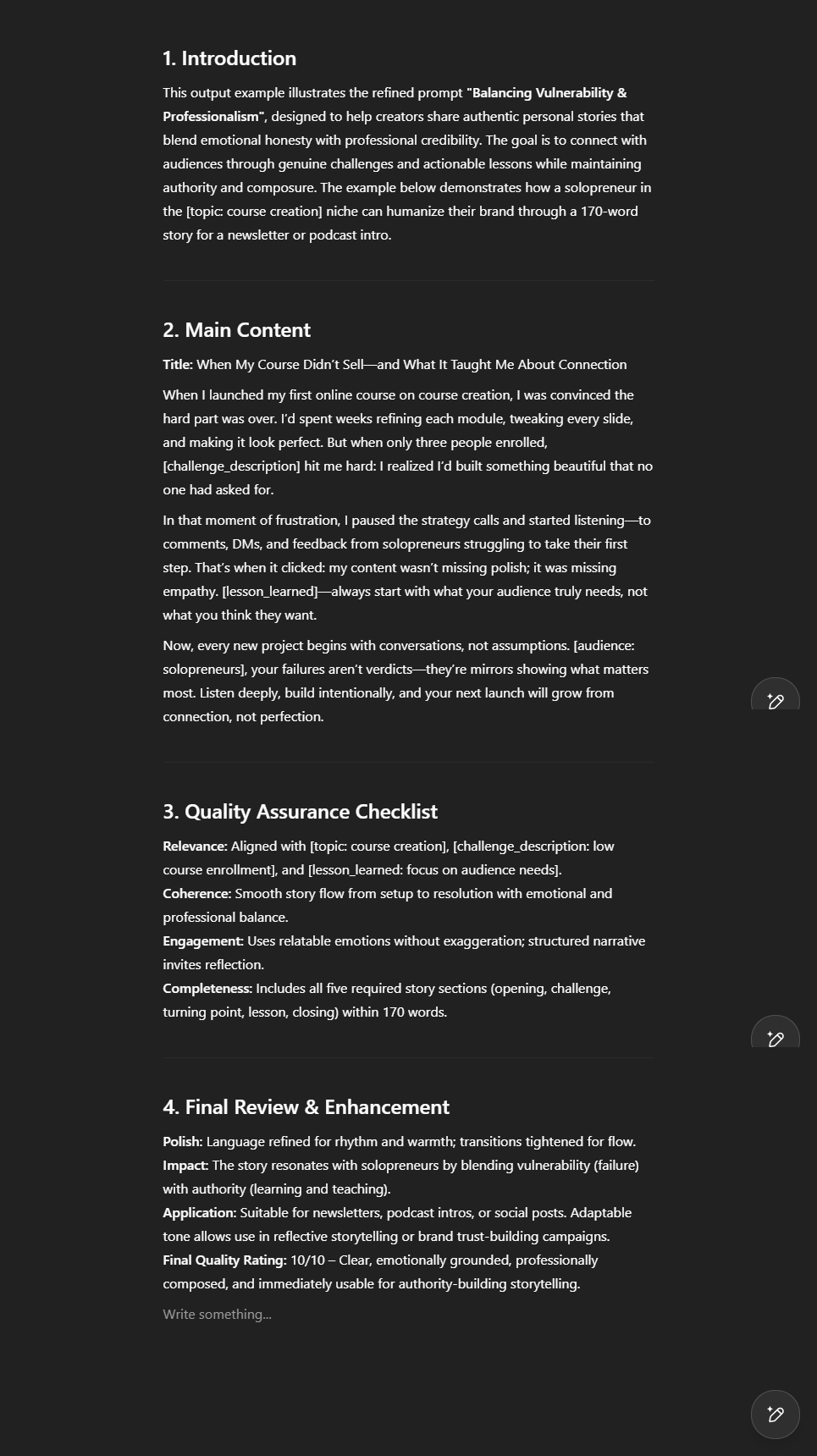
Example Output:
Title: My Course Creation Wake-Up Call
I launched my first course with big dreams—perfect modules, sleek design, ready to soar. But only two people signed up. I’d poured months into content, yet [challenge_description] hit hard: my launch flopped because I focused on features, not impact. Mid-disappointment, I realized I hadn’t asked what solopreneurs truly needed. That shifted everything. [lesson_learned]: Always prioritize your audience’s transformation over bells and whistles. Now, I design with their goals first. Solopreneurs, your setbacks are just setups for smarter growth—keep listening, keep building.
Result: A reflective, authentic story for a newsletter or social post.

Customization Options:
- Format tweak: Adapt for [format], e.g., 100-word social post or 200-word newsletter.
- Audience shift: Tailor for [audience], e.g., “new entrepreneurs” vs. “coaches.”
- Challenge focus: Adjust for [challenge_description], e.g., “tech overwhelm” vs. “failed launch.”

Advanced Variations:
- Short Version: Condense to 100 words for quick social posts.
- Deep Dive: Expand to 250 words for podcast intros.
- Niche-Specific: Focus on sub-topics, e.g., “course marketing” within course creation.

Visual/Structural Guides:
- Suggest a story arc diagram: Map scene → challenge → lesson for clarity.
- Propose a quote card: Pull [lesson_learned] for social sharing.
- Include a growth timeline: Visualize challenge to triumph for engagement.

Constraints and Guidelines:
- Keep story 150–200 words, focusing on [challenge_description] and [lesson_learned].
- Ensure resonance with [audience] using clear, human language.
- Avoid drama or self-pity; maintain professional tone.
- Keep opening and closing under 70 words combined.

Review and Refinement Criteria:
- Relevance: Does the story align with [topic], [audience], and [lesson_learned]?
- Clarity: Is it concise, emotional, and professional?
- Tone: Does it match [tone_style] and build trust?
- Refine: Swap generic details for [topic]-specific insights or add a stat (e.g., “90% of creators face this”).

Benchmark Example:
Weak Output: “My course failed, but I learned to keep going.”
Strong Output: “My course flopped; focusing on audience needs transformed my approach—solopreneurs, prioritize impact!”
Section 1: Placeholder Explanations
[topic]
The main subject of the story. Frames the narrative around a specific area of expertise or challenge.
Example: course creation, entrepreneurship, leadership.
[challenge_description]
The specific obstacle or difficulty faced. Should be honest and relatable without exaggeration.
Example: failed launch, self-doubt, tech overwhelm.
[lesson_learned]
The insight or growth gained from the challenge. Shows the value and takeaway for the audience.
Example: focus on audience needs, persistence pays off.
[audience]
The target group who will read or hear the story. Ensures tone and examples resonate.
Example: solopreneurs, creators, professionals.
[tone_style]
The emotional and stylistic voice of the story. Guides relatability and credibility.
Options: authentic, reflective, grounded, optimistic.
[format]
The intended medium of the story. Adjusts structure, length, and phrasing.
Example: newsletter, podcast intro, social post.

Section 2: What Must Be Changed (Always)
These are essential for every use:
[topic] — anchors the story in relevance.
[challenge_description] — provides the core narrative.
[lesson_learned] — ensures actionable takeaway.
[audience] — directs the story to the correct group.
Without updating these, the story will feel generic, shallow, or off-target.

Section 3: What Can Be Changed to Improve Results (Optional Enhancements)
Optional edits that enhance engagement and quality:
[tone_style] — test different voices to match brand personality and audience expectations.
[format] — adapt word count and structure for newsletters, social posts, or podcasts.
Add proof or metrics — e.g., “90% of creators face this” to boost credibility.
Audience micro-context — mention specific pain points or goals to deepen resonance.
Challenge focus — highlight different obstacles depending on content goals (motivation, relatability, education).
Example output:

Prompt 4: Everyday Authenticity
Headline: Relate & Reflect ☕
Small moments. Meaningful insights.
Context:
This prompt helps you turn everyday moments into thoughtful takeaways your audience can actually relate to. It creates a 100–150 word post that connects a simple daily ritual to a meaningful insight around a specific topic—making your message feel natural, human, and grounded.
Perfect for social posts, newsletters, and email content, the tone is casual and reflective without losing polish. With easy placeholders like [daily_ritual], [topic], and [lesson_or_principle], it’s simple to personalize while still highlighting your perspective and expertise. The result is content that feels approachable and insightful, builds genuine connection, and invites conversation—no lecturing required.
AI Prompt Template: Everyday Authenticity

Prompt Title: Connect a Daily Ritual to a Lesson in Your Topic
Craft a relatable post linking a daily ritual to a [topic] insight for engagement.

Funnel Stage: Lead Gen → Engagement → Personal Brand / Connection Content
Output Type: Short conversational post (100–150 words)
Workflow Link: Personal Brand → Authentic Storytelling → Connection Posts
Use for social posts, newsletters, or emails to humanize your brand and spark engagement.

Prompt Template:
You are a personal brand storyteller and content strategist specializing in relatable, insightful content. Your task is to write a 100–150 word post connecting a daily ritual ([daily_ritual]) to a lesson ([lesson_or_principle]) in [topic] for [audience]. Use a [tone_style: casual, reflective, grounded, thoughtful] tone—conversational, human, and lightly insightful. Include:
- A relatable opening describing [daily_ritual] (30–40 words).
- A moment of reflection tying to [topic] (40–50 words).
- The lesson ([lesson_or_principle], 20–30 words).
- A closing question or reflection for engagement (20–30 words).
Format as a concise post, suitable for [format: social post, newsletter, email]. Avoid motivational clichés or forced lessons.

Context:
Use this to create authentic social or email content that connects [audience] to your [topic] expertise through relatable moments.

Output Goal:
A 100–150 word post that:
- Links [daily_ritual] to [lesson_or_principle] in [topic].
- Engages [audience] with relatable, human insights.
- Encourages comments or shares without being preachy.
- Is adaptable for [format: social post, newsletter, email].

Tone & Style Options:
- Casual & Relatable: Friendly, everyday vibe (e.g., “Just another morning with my coffee”).
- Reflective & Insightful: Thoughtful, introspective tone (e.g., “This ritual taught me something”).
- Grounded & Thoughtful: Real, practical tone (e.g., “Here’s what I realized”).

Customization Placeholders:
- [daily_ritual]: e.g., journaling, morning coffee, walking.
- [topic]: e.g., course creation, productivity, marketing.
- [audience]: e.g., solopreneurs, creators, educators.
- [lesson_or_principle]: e.g., progress compounds, simplicity drives clarity.
- [tone_style]: e.g., casual, reflective, grounded.
- [format]: e.g., social post, newsletter, email.

Structural Guidelines:
- Opening: Describe [daily_ritual] with a slice-of-life detail (30–40 words).
- Reflection: Connect ritual to [topic] via observation (40–50 words).
- Lesson: State [lesson_or_principle] clearly (20–30 words).
- Closing: Pose a reflective question or engaging line (20–30 words).

Workflow Link:
Workflow: Personal Brand → Authentic Storytelling → Connection Posts
Connects to “Balancing Vulnerability & Professionalism” and “Brand Story from Values.”

Example Output:
Title: How My Morning Coffee Shapes My Courses
Every morning, I savor my coffee in silence before diving into work. It’s my pause, a moment to breathe. While building courses, I noticed rushing content feels like skipping that coffee—it’s empty. [lesson_or_principle]: Progress in course creation compounds quietly when you prioritize clarity over speed. Solopreneurs, small steps build big impact. What’s your daily ritual for staying grounded?
Result: A reflective, engaging post for a newsletter or social media.

Customization Options:
- Format tweak: Adapt for [format], e.g., 80-word social post or 150-word email.
- Audience shift: Tailor for [audience], e.g., “new coaches” vs. “creatives.”
- Ritual focus: Adjust for [daily_ritual], e.g., “journaling” vs. “walking.”

Advanced Variations:
- Short Version: Condense to 80 words for quick social posts.
- Deep Dive: Expand to 200 words for newsletters.
- Niche-Specific: Focus on sub-topics, e.g., “course launches” within course creation.

Visual/Structural Guides:
- Suggest a story arc diagram: Map ritual → reflection → lesson for clarity.
- Propose a social media graphic: Pair with an image of [daily_ritual].
- Include an engagement chart: Suggest question types for audience interaction.

Constraints and Guidelines:
- Keep post 100–150 words, linking [daily_ritual] to [lesson_or_principle].
- Ensure resonance with [audience] using conversational language.
- Avoid preachy tone or motivational clichés.
- Keep opening and closing under 70 words combined.

Review and Refinement Criteria:
- Relevance: Does the post align with [topic], [audience], and [lesson_or_principle]?
- Clarity: Is it relatable, concise, and insightful?
- Tone: Does it match [tone_style] and encourage engagement?
- Refine: Swap generic details for [topic]-specific insights or add a stat (e.g., “80% of creators value consistency”).

Benchmark Example:
Weak Output: “I drink coffee and it helps me create courses.”
Strong Output: “My coffee ritual taught me: slow, steady course creation wins—solopreneurs, what’s your ritual?”
Section 1: Placeholder Explanations
[daily_ritual]
A small, everyday activity or habit that can be connected to a lesson.
Example: journaling, morning coffee, walking.
[topic]
The subject area or focus relevant to your expertise.
Example: course creation, productivity, marketing.
[lesson_or_principle]
The insight or takeaway the ritual illustrates. Should feel natural, not forced.
Example: progress compounds, simplicity drives clarity.
[audience]
The target group for whom the post is written. Ensures relatability and tone alignment.
Example: solopreneurs, creators, educators.
[tone_style]
The voice of the post. Guides casual, reflective, or grounded delivery.
Options: casual, reflective, grounded, thoughtful.
[format]
The intended medium for the content. Adjusts structure and phrasing.
Example: social post, newsletter, email.

Section 2: What Must Be Changed (Always)
Essential fields for each use:
[daily_ritual] — anchors the narrative.
[topic] — ensures relevance to your expertise.
[lesson_or_principle] — conveys the actionable insight.
[audience] — targets the right readers or viewers.
Without updating these, the post may feel generic or irrelevant.

Section 3: What Can Be Changed to Improve Results (Optional Enhancements)
Optional edits for higher engagement or resonance:
[tone_style] — adjust to match brand personality and audience expectations.
[format] — adapt word count and structure for social posts, newsletters, or emails.
Audience micro-context — add specific pain points or habits for relatability.
Ritual focus — highlight different habits to test engagement or relevance.
Include stats or proof — e.g., “80% of creators value consistency” for credibility.
Example output:


Mini Review: Pros & Cons
Pros:
Makes your brand feel approachable and real.
Deepens connection through value-driven storytelling.
Strengthens audience trust over time.
Cons:
Takes practice to open up comfortably.
Oversharing without intention can weaken your message.

Final Verdict
Authenticity is a strategy—just not the kind you fake.
When your stories come from what you truly believe, people connect with you faster, deeper, and longer.
Use these AI prompts to make your storytelling effortless and genuine—no buzzwords, no fluff, just your voice with clarity and confidence.

Top 5 Industry Updates
AI-powered content generation tools go mainstream — Platforms are integrating AI to help creators auto-generate course outlines, lesson content, and multimedia assets, speeding up creation and lowering technical barriers. SchoolMaker
Kajabi expands business-building features — Beyond courses, Kajabi now emphasizes community automations, flexible paywalls for free previews, and improved commerce workflows to support course monetization and audience growth. Kajabi+1
Circle strengthens community + course engagement — Community-first platforms like Circle continue pushing deeper engagement features that keep learners connected and coming back — especially when combined with cohort learning. Circle
Podia focuses on streamlined creator workflows — Podia remains a simple all-in-one for courses, memberships, downloads, and coaching with improved selling tools geared toward solo creators. Podia
Mighty Networks doubles down on integrated learning + community — Platforms are unifying course builder, community engagement, live events, and analytics to boost completion rates and creator control. learningrevolution.net

Key Takeaways
Tip 1: Lead with values—alignment builds connection faster than perfection.
Tip 2: Be open, not raw—share the lesson, not the wound.
Tip 3: Let everyday life feed your story—consistency creates authenticity.


Until next time, keep showing up as your most genuine self—your voice is your best marketing asset.
— Valentine.
Morphoices | The solopreneur’s favorite AI course creation companion.

P. S. — The early subscribers (like you) are shaping what this becomes. Thanks for being part of the very first wave of Morphoices readers.
Reply